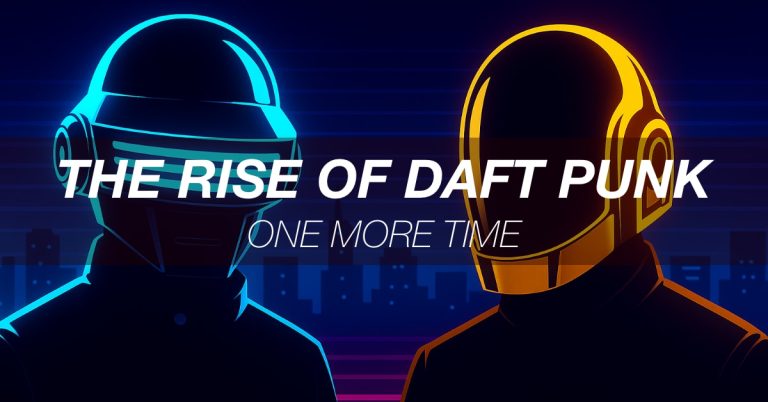
Twenty-five years after its release in November 2000, Daft Punk’s “One More Time” stands as one of electronic music’s most transformative achievements. With over 800 million Spotify streams, 500 million YouTube views, and 1 million digital sales in the US alone, this track redefined what electronic music could achieve in mainstream culture.
Voted “the greatest dance record ever made” by Mixmag readers, represents the pinnacle of Thomas Bangalter and Guy-Manuel de Homem-Christo’s artistic vision: transforming underground French house into a global phenomenon that would influence every corner of popular music.
The Foundation: From Parisian Bedrooms to Global Stages
Early Years and Formation (1987-1993)
Thomas Bangalter and Guy-Manuel de Homem-Christo first met in 1987 at Lycée Carnot, a secondary school in Paris. Both born in 1975, they bonded over shared musical interests and formed their first band, Darlin’, in 1992 with future Phoenix guitarist Laurent Brancowitz. The indie rock trio released a single on Stereolab’s Duophonic Records, but a Melody Maker review dismissed their music as “daft punky thrash”—an insult the duo would transform into their identity.
After Darlin’ disbanded in 1993, Bangalter and de Homem-Christo began experimenting with drum machines and synthesizers in Bangalter’s bedroom, recording their first tracks without any intention of releasing them.
The Homework Era (1993-1997)
The duo’s demo tape reached Stuart Macmillan of Slam, who signed “The New Wave” for his Soma Quality Recordings label in 1994. Released as a limited 500-copy run, the single sold out immediately and caught the attention of Virgin Records, though Daft Punk chose to remain with independent labels initially. Their follow-up single “Da Funk” (1995) became an underground sensation, eventually selling 30,000 copies and leading to their first major label deal with Virgin.
“Homework”, released on January 20, 1997, established Daft Punk as electronic music innovators. Recorded entirely in Bangalter’s bedroom studio. The album achieved remarkable commercial success: over 2 million copies sold worldwide, including 150,000 in the UK where it peaked at #8. The album spawned multiple singles including “Around the World,” which reached #5 in the UK.
The Discovery Sessions: Creating “One More Time”
Recording and Production (1998-2000)
Between 1998 and 2000, Daft Punk worked on their sophomore album Discovery at their Daft House studio in Paris.
“One More Time” was actually completed in 1998—two full years before its release. This patient approach defined Daft Punk’s methodology: the track “sat on a shelf” for nearly three years while they perfected the rest of Discovery. The delay proved prescient, as Auto-Tune technology had only been released commercially in late 1997, and audiences needed time to appreciate its creative rather than corrective potential.
The Romanthony Connection
The track features vocals from Romanthony (Anthony Wayne Moore), a house producer from New Jersey whom Daft Punk discovered through his underground releases. Romanthony recorded his vocals separately, which were then processed through extreme Auto-Tune and vocoder effects, creating the signature sound.
The Sample Controversy
The foundation of “One More Time” rests on a sample from Eddie Johns’ 1979 disco track “More Spell on You.” In 2021, journalist August Brown revealed that Johns, who had been homeless and destitute for decades after suffering a stroke, never received royalties despite the song’s massive success. Daft Punk’s representatives confirmed they had been paying royalties twice yearly since 2000 to GM Musipro, the French publishing company that acquired the rights in 1995, but Johns remained untraceable to the rights holders.
The story served as a sobering reminder that even the most iconic dance anthem carries human consequences behind the scenes — a contrast to the song’s euphoric message of unity.
Chart Performance and Commercial Impact
Initial Release Success
“One More Time” was released as Discovery’s lead single on November 13, 2000, achieving immediate global success:
Peak Chart Positions:
- #1 in France, Canada, and Portugal
- #2 in the UK (their highest-charting single until “Get Lucky” in 2013)
- #3 in Austria, Belgium, and Ireland
- #4 in Switzerland
- #5 in Finland and Sweden
- #6 in Denmark and New Zealand
- #9 in Norway
- #10 in Australia
- #61 on US Billboard Hot 100 (but #1 on Dance Club Play and Dance Singles Sales)
The song made history by debuting at #1 on the Eurochart Hot 100 Singles—one of the few tracks ever to achieve this feat. It spent 28 weeks on the UK Singles Chart and 23 weeks on the Australian charts, demonstrating remarkable longevity.
Sales and Certifications
Certifications achieved:
- Platinum in the UK (600,000+ units)
- Platinum in Denmark and Italy
- Gold in Australia, Belgium, France, Germany, Poland, Portugal, Spain, and Switzerland
By June 2013, the song had sold 1,052,000 digital copies in the United States, becoming Daft Punk’s first million-seller. Total UK sales now exceed 806,000 copies, with the single achieving 59,000 first-week paid sales—the highest debut among all Daft Punk singles.
Streaming Era Dominance
In the streaming age, “One More Time” has accumulated:
- Over 800 million Spotify streams
- 500 million YouTube views for the official music video
- Estimated 1+ billion total streams across all platforms
Remarkably, in January 2023, the song returned to Beatport’s House Top 100 chart at #94—22 years after its original release—proving its enduring relevance to contemporary DJ culture.
Discovery: The Album That Changed Everything
Commercial Performance
Discovery was released on March 12, 2001, achieving:
- #2 in the UK
- #23 on US Billboard 200
- Triple Platinum in France (600,000+ shipments)
- Gold in the US (802,000 copies sold by May 2013)
- At least 2.6 million copies sold worldwide
Critical Reassessment
Initial reviews were mixed. Pitchfork gave it 6.4/10, with reviewer Ryan Schreiber calling it a “Frankenbaby.” However, in an unprecedented move, Pitchfork upgraded their score to 10/10 in 2021, stating: “Discovery is the centerpiece of their career, an album that transcended the robots’ club roots and rippled through the decades that followed.”
Current rankings include:
- #236 on Rolling Stone’s 500 Greatest Albums of All Time (2020)
- #23 on Apple Music’s 100 Best Albums (2024)
- #6 Best Electronic Album of All Time by British GQ (2023)
Discovery’s fusion of sampling, vocoder vocals, and emotional storytelling became the DNA of modern electronic pop. From The Weeknd’s Starboy to Porter Robinson’s Nurture and even Kanye West’s Stronger, the album’s influence reverberates through every generation that followed.
The Alive Tour Phenomenon (2006-2007)
Coachella’s Turning Point
Daft Punk’s performance at Coachella on April 29, 2006, became legendary. Approximately 40,000 people attempted to enter the 10,000-capacity Sahara Tent. The show, featuring their iconic LED pyramid stage, is credited as “the tipping point” for EDM in America.
The Cultural Milestone…
“One More Time” represents the perfect synthesis of Daft Punk’s artistic vision—humanity through technology, joy through repetition, and universality through simplicity. Released at the dawn of the new millennium, it prophetically outlined the next two decades of popular music while maintaining a timeless quality that transcends trend cycles.
The song’s journey from a track that sat completed for three years to becoming the greatest dance record ever made exemplifies Daft Punk’s patient perfectionism. Its influence extends far beyond electronic music, reshaping pop production, live performance standards, and artist presentation across all genres.
Twenty-five years later, as we continue streaming, remixing, and celebrating “One More Time,” we’re not just listening to a song—we’re experiencing a cultural milestone that proved electronic music could be both commercially massive and artistically profound.